Compare
Kiki vs Spot
Quick verdict
Spot leads on 5 of 9 comparable rows
Kiki leads on Data Freshness, Battery, Price, and Social Interaction. Spot leads on Reality Score, Countries, Perception, and Autonomy (+1 more).
Who should choose which?

Choose Kiki if…
- Budget is a priority and Kiki lists lower ($1,499).
- Your main goal is conversation, which Kiki targets directly.
- Strengths like social interaction and perception match how you plan to use it at home.
- You prefer a desktop form factor over the alternatives in this compare.
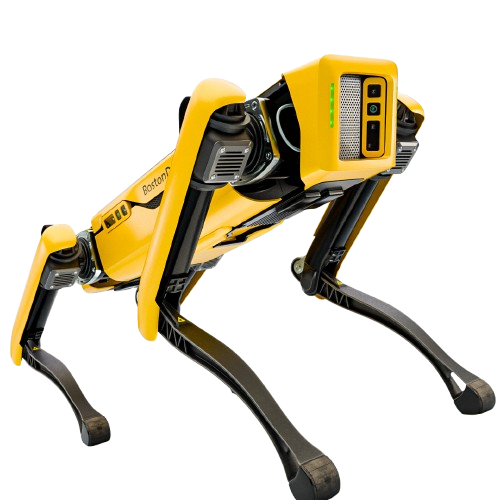
Choose Spot if…
- Verified shipping and public proof matter more to you (reality score 93/100).
- Your main goal is home assistant, which Spot targets directly.
- Strengths like mobility and perception match how you plan to use it at home.
- You prefer a animal-like form factor over the alternatives in this compare.
| Spec | Kiki  Zoetic AILeads 4 Zoetic AILeads 4 | Spot  Boston DynamicsLeads 5 Boston DynamicsLeads 5 |
|---|---|---|
| Performance | ||
| Readiness Score | 58 | 58 |
| Reality Score | 54 | 93 |
| Data Freshness | 100% | 85% |
| Speed | Not mobile | 5.8 km/h |
| Payload | Unknown | 14 kg |
| Specs | ||
| Height | 25 cm | 61 cm |
| Weight | 1.8 kg | 33.8 kg |
| Battery | 4–6 h | 1.5 h |
| Form | Desktop | Animal-like |
| Availability | ||
| Price | $1,499 | $74,500+ |
| Market Status | Discontinued | Limited |
| Availability | Discontinued | Limited |
| Countries | United States | United States, United Kingdom, Canada, Germany, Japan, Australia, Singapore |
| Intelligence | ||
| Mobility | Unknown | 96 |
| Manipulation | Unknown | 48 |
| Perception | 80 | 90 |
| Autonomy | 62 | 88 |
| Social Interaction | 92 | 12 |
| Home Navigation | 5 | 72 |
| Sensors | Nose camera (facial recognition), 4× beamforming mics, 16 touch sensors, accelerometer | 5× stereo camera pairs (360° vision), IMU, joint encoders; optional Spot CAM+, LiDAR, thermal payloads |
| Connectivity | Wi-Fi, Bluetooth, iOS/Android companion app | Wi-Fi, Ethernet (payload-dependent); tablet controller link |
| Ecosystem | Zoetic AI companion app (iOS and Android); Reinforcement learning personality engine; Neural imprint personality backup (announced) | Spot SDK (Python); Autowalk mission recording; Orbit fleet management; Spot Arm (optional); Spot CAM+ / LiDAR payloads; Scout software for inspection |
Green cells mark the stronger value in each row across 2 robots.