Two humanoids passed tools in a Seoul operating room. They did not operate.
Samsung Medical Center showed two humanoids handing instruments, holding a camera, and retracting tissue on a goat-liver drill. First human trials are aimed at 2029. Not a home product.
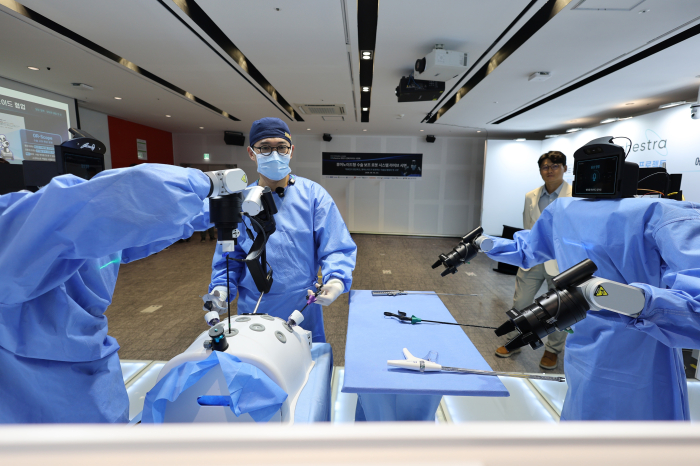
A Seoul surgeon stood over a goat liver with no human assistant at the table. Two humanoids passed tools, held the camera, and pulled tissue when he asked. KED Global flagged the Wednesday, September 16, 2026 drill at Samsung Medical Center. Transplant surgeon Oh Nam-ki was running an endoscopic gallbladder removal on animal tissue, not a patient.
This is extra hands in the room. It is not a robot surgeon. The hospital says the machines do not judge a case on their own.
Goat liver, two robots
Korea Biomedical Review was in the room. One pass had a surgeon driving a robot to cut, dissect, and stitch. Another pass was what the team calls solo surgery: one operator, two assisting humanoids, no scrubbed-in helper. ENT professor Jung Yong-gi leads the project. He wants a full tool cycle (ask, hand over, use, take back, tidy), not a one-off pass of an instrument.
Lab numbers from the hospital: five instrument types grasped 100% of the time, delivered 98.7% of the time, motion starting within two seconds of a voice command. Ambiguous orders get a re-check before the arm moves. An endoscope robot can keep the view on a tool, or on the midpoint of two tools, without tearing the incision.
Jung told reporters the robots are slower than a person today. He thinks they can match a person's pace by the time the grant ends. The pitch is staffing, not spectacle. Smaller hospitals cannot hire enough skilled assistants. Holding a camera or retracting tissue is the job they want to offload first.
Not a home kit, and not approved yet
The stack is a Korean consortium branded ORchestra. Rainbow Robotics builds the body. AIDIN Robotics builds the hand (each finger joint has a touch sensor, about 50 readings a second, per AIDIN's CTO). Universities and other hospitals supply AI and surgical data. Government money is about 13.84 billion won (about $10 million) over five years, year two, still a proof of concept. A review later this year decides if it gets a second phase.
First human trials are aimed at 2029, starting with lower-risk camera work, then laparoscopic view and tissue pull. The hospital expects a tightly regulated medical device path (class III), animal studies, factory quality rules, and Korean drug-safety approval. Commercial sales, if any, would go through Rainbow and AIDIN as hospital buy or lease. Jung said it should not raise what patients pay.
This is not Unitree G1. Last July, UC San Diego ran live-animal gallbladder cases on G1 kits with surgeons at a console. Seoul's demo is a different body, in-room assistants, and a staffing story. We are not adding an ORchestra row to the catalog. There is no home cart and no list price. G1 stays the catalog humanoid you can actually order if you want a developer biped, not an OR nurse.

Covers product launches, demos, and week-to-week moves in the home robot market.
Be the first to share a question or hands-on note.